The Question
What does designing for emergencies look like in a world we've never lived in?
A World Beyond Earth
In a hypothetical future twenty years from now, humanity inhabits self-sustaining spacecraft designed to support life and communities beyond Earth.

Emergency Response
A manual emergency alarm designed for turbulence due to collision events within a future habitable spacecraft, activated to trigger safety protocols when automation fails.


A Secure and Intentional Interaction.
The activation sequence begins with an intentional user action before the emergency protocol can be engaged.

A Universal Signal of Urgency
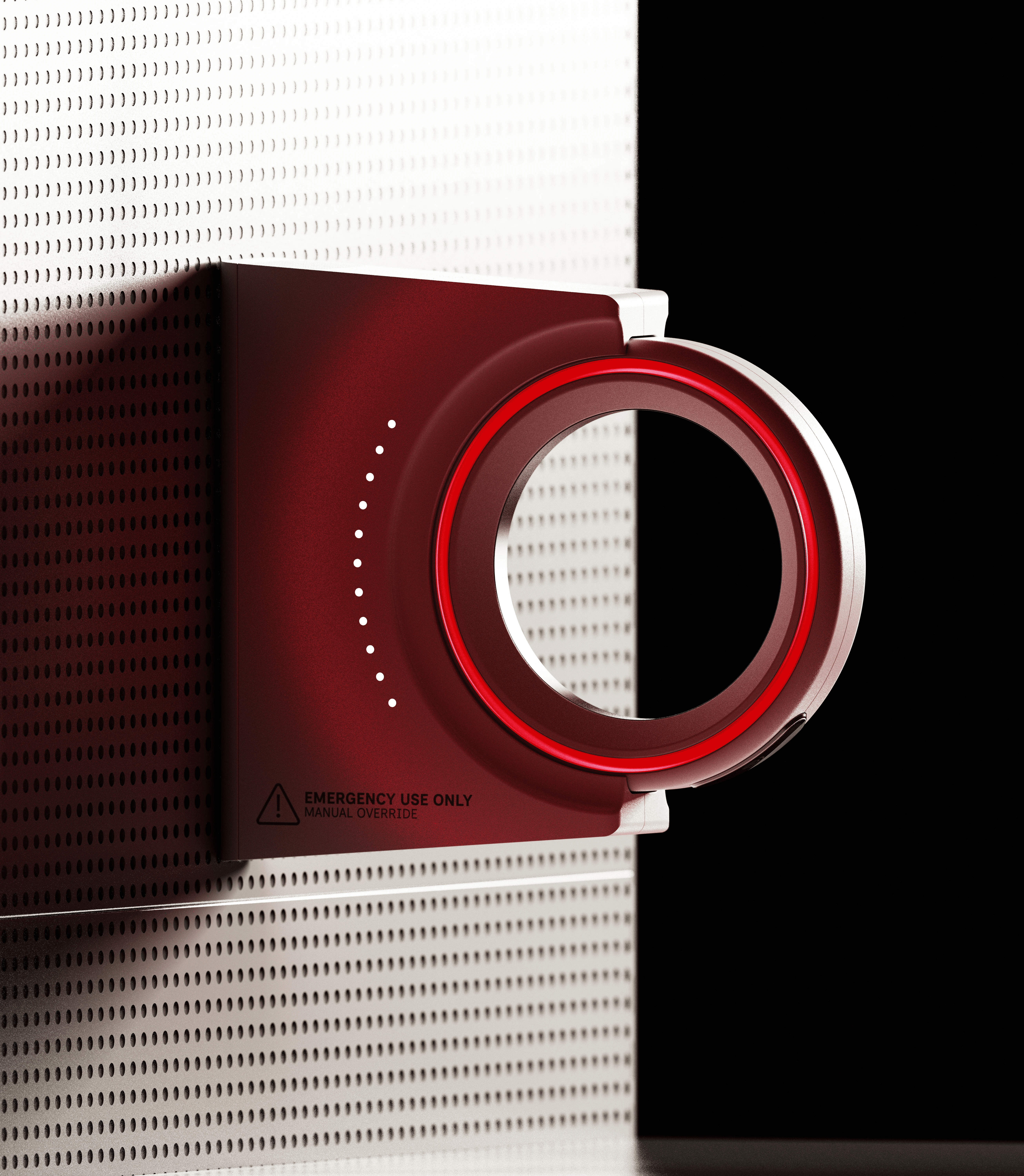

The Interaction Sequence


The Process
World Building
Classmates and I brainstormed speculative future environments shaped by climate change, AI-driven infrastructure, and human migration beyond Earth. Together, we developed the concept of a habitable spacecraft

Revisiting the Design


Prototypes
Through multiple rounds of sketching, foamcore mockups, and 3D-printed prototypes, I explored how form, interaction, ergonomics, and visibility could shape a more intuitive emergency response experience.

A Working Physical Prototype
Developed during the original project to validate the activation mechanism. Following the project, the final design was refined to improve ergonomics, form, and visual integration while preserving the core interaction.
Fabrication
Soldered and integrated internal electronic components, including a reed switch and coded an Arduino-controlled lighting system that flashes red when activated. Fabricated the exterior through 3D printing and refined the surface finish using Bondo and primer.


